Group
CO - National Institute for Research and Development in Microtechnologies
IMTBucharest:
Laboratory for Molecular Nanotechnology
MAIN AREAS: The Molecular Nanotechnology Laboratory belongs to the IMT's Center for Nanotechnologies (CNT), under the aegis of Romanian Academy of Sciences. Based on its multidisciplinary background and experience, the team aims towards major scientific achievements and recognition in the following areas: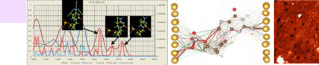 functional
integration of biological components (peptides, proteins, antibodies, DNA or DNA-like
nucleotides and fragments etc.) with micro/nano processed inorganic structures, addressing three areas:
functional
integration of biological components (peptides, proteins, antibodies, DNA or DNA-like
nucleotides and fragments etc.) with micro/nano processed inorganic structures, addressing three areas:
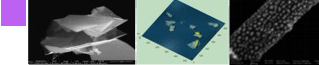 investigation and control of physico-chemical properties of new nanomaterials, with the following two accents:
MAIN AREAS:
The aim of European Centre of Excellence in Microwave, Millimetre Wave and Optical Devices is to bring the
research activity in Radio-Frequency (RF) and Optical-MEMS at the National Institute for R&D in
Microtechnologies (IMT-Bucharest) to the highest European level in Advanced Communication Systems and
Sensors.
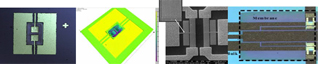 The research on RF-MEMS will focus on three sub-topics: Development of silicon micromachined circuits for microwave and
millimetre wave communication systems; Development of GaAs monolithic integrated micromachined receiver
modules; and Development of Surface Acoustic Wave (SAW) and Bulk Acoustic Wave (BAW) structures on GaN and
AlN membranes.
The research on RF-MEMS will focus on three sub-topics: Development of silicon micromachined circuits for microwave and
millimetre wave communication systems; Development of GaAs monolithic integrated micromachined receiver
modules; and Development of Surface Acoustic Wave (SAW) and Bulk Acoustic Wave (BAW) structures on GaN and
AlN membranes.
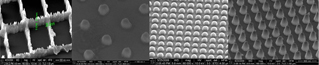 The research
on Optical-MEMS will focus on two sub-topics: Heterogeneous integration of silicon and polymer-based
micro-photonic devices to improve the functionality and the performance of Optical-MEMS and Sub-wavelength
photonic structures for highly integrated optical systems.
The research
on Optical-MEMS will focus on two sub-topics: Heterogeneous integration of silicon and polymer-based
micro-photonic devices to improve the functionality and the performance of Optical-MEMS and Sub-wavelength
photonic structures for highly integrated optical systems.
P2 - Faculty of Chemistry and Chemical Engineering, Babes-Bolyai University,
ORGANIC and SUPRAMOLECULAR CHEMISTRY Laboratory
MAIN AREAS:
The aim of European Centre of Excellence in Microwave, Millimetre Wave and Optical Devices is to bring the
research activity in Radio-Frequency (RF) and Optical-MEMS at the National Institute for R&D in
Microtechnologies (IMT-Bucharest) to the highest European level in Advanced Communication Systems and
Sensors.
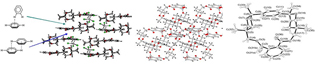 The design,
synthesis and structural analysis of architecturally new cyclophanes (monomers, dimers,
and trimers) are reported. Variable temperature NMR experiments reveal a regular, tandem
dynamic in the cyclophane 2a that enables its description as a "molecular rocking chair". The NMR
and X-ray structure investigations show important intra- and intermolecular aromatic -stacking
interactions.
The design,
synthesis and structural analysis of architecturally new cyclophanes (monomers, dimers,
and trimers) are reported. Variable temperature NMR experiments reveal a regular, tandem
dynamic in the cyclophane 2a that enables its description as a "molecular rocking chair". The NMR
and X-ray structure investigations show important intra- and intermolecular aromatic -stacking
interactions.
The good yields synthesis and the structural analysis of some new [4.4]cyclophanes obtained from appropriate 1,3-dioxane derivatives of 1,4-diacetylbenzene are reported. The X-ray structures and the NMR investigations revealed important intra and intermolecular pi-stacking and the free or hindered rotation of the aromatic groups. The bordering 1,3-dioxane rings showed an highly unusual resistance for the hydrolysis reaction.
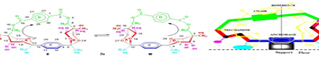 New molecular
rotors, [7.7](2,6)pyridinocyclophanes (monomers and dimers) embedding 1,3-dioxanes in the bridges, were
investigated by variable temperature NMR, molecular modeling, and single crystal X ray diffractometry. The
nitrogen-inside rotation of the pyridine ring is more hindered in the derivatives with longer distance
between the bridges (i.e. para > meta and 2,6-pyridylen > ortho) and can be chemically stopped by
complexation with CF3SO3Ag
New molecular
rotors, [7.7](2,6)pyridinocyclophanes (monomers and dimers) embedding 1,3-dioxanes in the bridges, were
investigated by variable temperature NMR, molecular modeling, and single crystal X ray diffractometry. The
nitrogen-inside rotation of the pyridine ring is more hindered in the derivatives with longer distance
between the bridges (i.e. para > meta and 2,6-pyridylen > ortho) and can be chemically stopped by
complexation with CF3SO3Ag
The design, synthesis and structural analysis of architecturally new cyclophanes (monomers, dimers, and trimers) are reported. Variable temperature NMR experiments reveal a regular, tandem dynamic in the cyclophane 2a that enables its description as a "molecular rocking chair". The NMR and X-ray structure investigations show important intra- and intermolecular aromatic -stacking interactions.
MAIN AREAS: Our research in nanophotonics is focused on the design and fabrication of periodic metal/polymer/semiconductor nanostructures with multifunctional optical and spectroscopic properties. We employ the self-assembly (SA) and nanosphere lithography (NL) as fabrication techniques as well as a large variety of advanced optical spectroscopies and rigourous theoretical methods (RCWA) for analysis and characterization. The optical response of nanostructures we fabricate is dominated by the nano-excitation of surface plasmons and display interesting band structures and enhanced local electromagnetic fields. They offer a potential for nanoscale manipulating of light fields and provide active-substrates for surface-enhancement of Raman scattering (SERS) and IR absorption (SEIRA), optical chemo- and biosensing (SPR), as well as the control of fluorescence decay, fluorescence resonance energy transfer (FRET) and optical properties of nanostructured materials.
Laboratory for Molecular Nanotechnology
MAIN AREAS: The Molecular Nanotechnology Laboratory belongs to the IMT's Center for Nanotechnologies (CNT), under the aegis of Romanian Academy of Sciences. Based on its multidisciplinary background and experience, the team aims towards major scientific achievements and recognition in the following areas:
functional
integration of biological components (peptides, proteins, antibodies, DNA or DNA-like
nucleotides and fragments etc.) with micro/nano processed inorganic structures, addressing three areas:
- creating new, application oriented, properties by physical and chemical modifications (physical processes, organic or inorganic doping)
- devising microsystems and devices using controlled manipulations and bio-non-bio assembly on/with surfaces, 1D and 0D materials
- developing structures and methods for molecular detection and identification, based on optimally integrated electrical, chemical, optical effects
investigation and control of physico-chemical properties of new nanomaterials, with the following two accents:
- synthesis of new superconductor materials in bulk or thin films and novel thin films of complex oxides with controllable morphological and electrical transport properties and further coupling to molecular nanostructures (e.g. graphene)
- carbon-based nanomaterials (CNT's, graphene, carbon dots etc.): synthesis, assembly and development of nanocomposites with optimal properties for energy harvesting, thermal and biomedical applications
P1 - National Institute for Research and Development in Microtechnologies
IMTBucharest:
European Centre of Excellence in Microwave, Millimetre Wave and Optical Devices, based
on Micro-Electro-Mechanical Systems for Advanced Communication Systems and Sensors" –
MIMOMEMS
Micro-Nano Photonics Laboratory - L3
The research on RF-MEMS will focus on three sub-topics: Development of silicon micromachined circuits for microwave and
millimetre wave communication systems; Development of GaAs monolithic integrated micromachined receiver
modules; and Development of Surface Acoustic Wave (SAW) and Bulk Acoustic Wave (BAW) structures on GaN and
AlN membranes.
The research
on Optical-MEMS will focus on two sub-topics: Heterogeneous integration of silicon and polymer-based
micro-photonic devices to improve the functionality and the performance of Optical-MEMS and Sub-wavelength
photonic structures for highly integrated optical systems.
P2 - Faculty of Chemistry and Chemical Engineering, Babes-Bolyai University,
ORGANIC and SUPRAMOLECULAR CHEMISTRY Laboratory
The design,
synthesis and structural analysis of architecturally new cyclophanes (monomers, dimers,
and trimers) are reported. Variable temperature NMR experiments reveal a regular, tandem
dynamic in the cyclophane 2a that enables its description as a "molecular rocking chair". The NMR
and X-ray structure investigations show important intra- and intermolecular aromatic -stacking
interactions.
The good yields synthesis and the structural analysis of some new [4.4]cyclophanes obtained from appropriate 1,3-dioxane derivatives of 1,4-diacetylbenzene are reported. The X-ray structures and the NMR investigations revealed important intra and intermolecular pi-stacking and the free or hindered rotation of the aromatic groups. The bordering 1,3-dioxane rings showed an highly unusual resistance for the hydrolysis reaction.
New molecular
rotors, [7.7](2,6)pyridinocyclophanes (monomers and dimers) embedding 1,3-dioxanes in the bridges, were
investigated by variable temperature NMR, molecular modeling, and single crystal X ray diffractometry. The
nitrogen-inside rotation of the pyridine ring is more hindered in the derivatives with longer distance
between the bridges (i.e. para > meta and 2,6-pyridylen > ortho) and can be chemically stopped by
complexation with CF3SO3Ag
The design, synthesis and structural analysis of architecturally new cyclophanes (monomers, dimers, and trimers) are reported. Variable temperature NMR experiments reveal a regular, tandem dynamic in the cyclophane 2a that enables its description as a "molecular rocking chair". The NMR and X-ray structure investigations show important intra- and intermolecular aromatic -stacking interactions.
Contact info:
Center of Nanotechnology, Laboratory for Molecular NanotechnologyNational Institute for Research and Development in Microtechnologies - IMT Bucharest
Address: 126A, Erou Iancu Nicolae Street R-077190, Voluntari, Ilfov, Romania
Tel: +40-21-269.07.70 (ext. 19)
Fax: +40-21-269.07.72
E-Mail: monica[dot]veca[at]imt[dot]ro.
